Scrap metal can come from many everyday sources, including old household appliances, damaged machinery, unused metal equipment, building materials and vehicle parts. Instead of allowing these materials to become unnecessary waste, responsible handling can help recover valuable metals and return them to useful production.
However, collecting, buying and selling scrap metal is not simply a matter of transporting unwanted materials. The industry operates under legal requirements designed to discourage metal theft, improve traceability and support responsible waste management.
This is why choosing a Licensed Scrap Metal Dealer matters. A properly licensed business is subject to specific rules about accepting scrap metal, checking supplier identities, keeping transaction records and handling payments.
For anyone looking for a reliable Scrap Metal Merchant, understanding these requirements can help them make a more informed decision. It also helps households, tradespeople and businesses recognise the difference between a legitimate scrap metal operation and an unverified collector.
This Scrap Metal Licensing Guide explains what a licensed dealer does, which regulations are relevant, how waste carrier registration differs from dealer licensing and what customers should consider before handing over unwanted metal.
At DP The Scrap Metal Collection and Merchant, responsible scrap handling and clear processes are important parts of the recycling journey. Understanding the legal framework helps customers appreciate why proper documentation and responsible collection practices matter.
What Is a Licensed Scrap Metal Dealer?
A Licensed Scrap Metal Dealer is a person or business authorised to trade in scrap metal under the applicable licensing rules.
In England and Wales, the main legislation is the Scrap Metal Dealers Act 2013. It requires businesses operating as scrap metal dealers to hold the appropriate licence issued by their local authority.
The legislation covers businesses that buy or sell scrap metal as part of their trade, including businesses that operate from a fixed site and those that collect metal from different locations.
A licensed dealer must follow specific requirements relating to:
- Supplier identity checks.
- Transaction records.
- Metal descriptions and weights.
- Payment methods.
- Licence display.
- Responsible handling and disposal of scrap metal.
These requirements help create a clearer record of where scrap metal comes from and where it goes.
What Counts as Scrap Metal?
Scrap metal is not limited to rusty iron or discarded steel. It can include old, waste or discarded metal materials, as well as certain broken, worn-out or unwanted products containing metal.
Common examples include:
- Steel and iron components.
- Aluminium frames and sheets.
- Copper pipes and cables.
- Brass fittings.
- Metal machinery parts.
- Damaged metal equipment.
- Certain discarded household appliances.
- Broken metal fixtures and fittings.
The legal definition under the Scrap Metal Dealers Act 2013 includes certain metal products and assemblies that have reached the end of their useful life. Gold, silver and alloys containing at least 2% gold or silver by weight are excluded from the Act’s definition of scrap metal.
The condition and intended use of an item can therefore matter when deciding whether it falls within the legislation.
Why Does a Scrap Dealer Need a Licence?
Licensing helps make the scrap metal industry more accountable.
Metal can have considerable resale and recycling value. Unfortunately, some materials may be stolen from construction sites, commercial premises, public infrastructure or private properties.
Without proper controls, stolen metal can enter the recycling chain and become difficult to trace.
The licensing system helps address this problem by requiring dealers to follow procedures that make transactions more transparent.
1. It Helps Discourage Metal Theft
One of the main purposes of scrap metal regulation is to reduce opportunities for stolen metal to be traded through legitimate businesses.
A dealer must verify the identity of people supplying scrap metal and maintain appropriate transaction records.
For example, someone offering a quantity of copper cable should expect the dealer to follow identity verification procedures. If the circumstances surrounding the material raise concerns, the dealer should not simply accept it without appropriate checks.
These procedures help create accountability and discourage the sale of materials that may not belong to the supplier.
2. It Supports Traceable Transactions
A properly managed transaction should leave a record.
In England and Wales, the Scrap Metal Dealers Act 2013 sets out information that dealers must record when receiving and disposing of scrap metal.
Depending on the transaction and licence type, records can include:
- Description and type of metal.
- Condition and weight.
- Date and time of receipt.
- Vehicle registration details where applicable.
- Supplier’s full name and address.
- Payment information.
- Details of the metal’s disposal.
These records help establish a transaction history and support checks by the relevant authorities.
3. It Encourages Responsible Business Practices
Licensing is not simply an administrative formality. It creates clear expectations for businesses operating in the scrap metal sector.
A responsible dealer needs to understand the rules that apply to its activities and maintain procedures that support compliance.
This includes keeping accurate records, checking supplier information, displaying the required licence and ensuring that scrap metal is handled through appropriate channels.
For customers, these requirements offer a useful starting point when deciding which business to approach.
Understanding the Scrap Metal Dealers Act
The Scrap Metal Dealers Act 2013 is the principal licensing framework for scrap metal dealers in England and Wales.
It establishes the requirement for a scrap metal licence and explains the main responsibilities that licensed dealers must follow.
Site Licence and Collector’s Licence
The Act provides two main licence types.
Site licence
A site licence is relevant to a dealer operating from one or more authorised business sites within the licensing authority’s area.
It identifies the sites covered by the licence and the relevant site managers.
The licence must be displayed prominently at each authorised site in an area accessible to the public.
Collector’s licence
A collector’s licence applies to a business operating as a mobile scrap metal collector within a particular local authority area.
The licence must be displayed on vehicles used for the business in a way that can be read by someone outside the vehicle.
A mobile collector generally needs the appropriate licence for each local authority area in England and Wales where they collect scrap metal.
These licences are not interchangeable. The appropriate type depends on how and where the business operates.
Identity Verification Requirements
A licensed dealer must verify the full name and address of the person supplying scrap metal before receiving it.
Verification must rely on documents, data or other information obtained from a reliable and independent source.
This requirement helps prevent anonymous transactions and makes it more difficult for stolen metal to enter the legitimate recycling chain.
Customers should understand that being asked for identification is part of the regulated process. It is not necessarily a sign that a dealer is treating them with suspicion.
Cash Payment Restrictions
Another important requirement under the Scrap Metal Dealers Act 2013 is the prohibition on cash payments for scrap metal purchases in England and Wales.
Dealers must use permitted non-cash payment methods, such as cheque or electronic transfer, in accordance with the legislation.
This creates a clearer payment record and makes transactions easier to trace.
If a business offers cash for scrap metal in circumstances covered by the Act, customers should treat this as a reason to check whether the transaction is being handled lawfully.
Environment Agency Registration and Waste Carrier Responsibilities
A common misunderstanding is that holding a scrap metal dealer licence automatically covers every waste-related activity.
It does not.
Scrap metal dealer licensing and waste carrier registration are separate regulatory requirements. A business may need to meet both, depending on the activities it carries out.
What Is a Waste Carrier?
A Waste Carrier is a person or business that transports waste as part of its activities.
Scrap metal that has been discarded and is being handled as waste can fall within waste management rules. A business transporting this material may therefore need the relevant waste carrier registration.
For businesses in England, waste carrier, broker and dealer registration is administered by the Environment Agency.
The registration requirements depend on the type of activity being carried out.
For example:
- A business transporting waste may need carrier registration.
- A business buying, selling or disposing of waste may need dealer registration.
- A business arranging waste transactions for another party may need broker registration.
A business should assess its actual activities rather than assume that one registration covers everything.
Why Waste Carrier Licence Requirements Matter
People often use the phrase Waste Carrier Licence when referring to waste carrier registration.
The important point is that businesses must have the appropriate registration when their activities fall within the relevant waste rules.
This helps ensure that waste is moved through accountable channels rather than being abandoned or passed to an unknown recipient.
For example, a business collecting unwanted metal from a commercial property should consider whether the material is legally classified as waste and whether its collection and transport activities require registration.
Customers can also take sensible precautions by checking that the business they use has the appropriate authorisation for the work it carries out.
What About Other UK Nations?
The rules are not identical throughout the United Kingdom.
The Scrap Metal Dealers Act 2013 licensing framework described above applies to England and Wales.
Scotland has a separate metal dealer licensing system under the Civic Government (Scotland) Act 1982. Different licensing arrangements apply to regular premises-based dealers and itinerant metal dealers.
Northern Ireland also has its own waste regulatory framework.
Waste carrier registration is administered by the relevant environmental regulator in each nation. Therefore, businesses operating across borders should check the requirements that apply in every location where they work.
This distinction is important for any company that collects or trades scrap metal in more than one part of the UK.
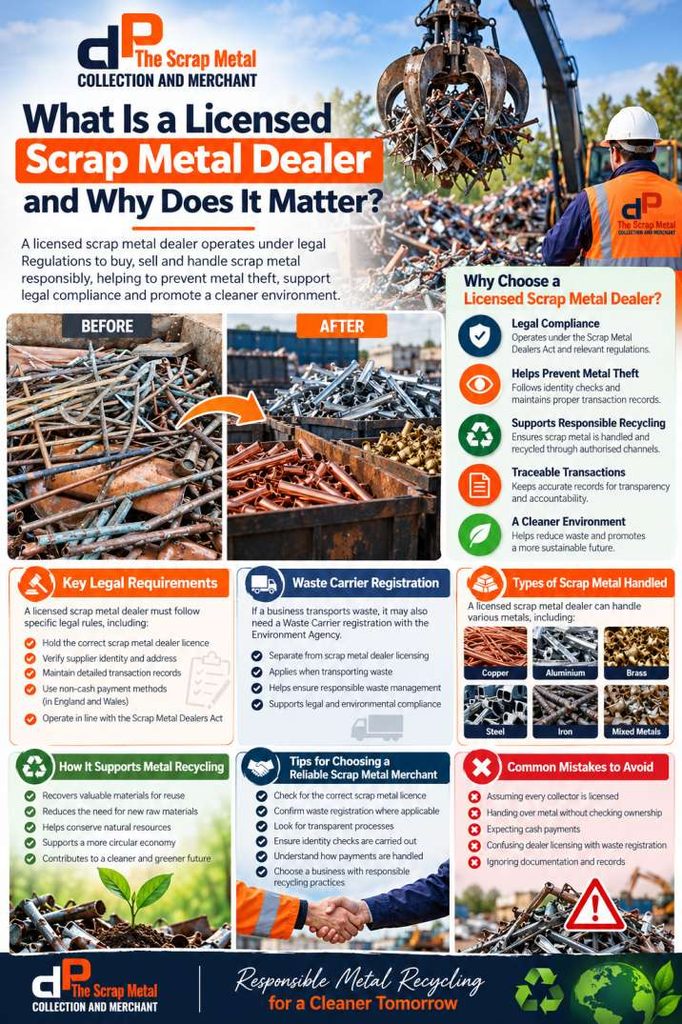
What Customers Should Check Before Choosing a Scrap Metal Merchant
Choosing a Scrap Metal Merchant should involve more than finding someone willing to collect unwanted metal.
Customers should consider whether the business operates transparently, understands its legal responsibilities and can explain how it handles the material.
Here are some practical checks.
1. Ask About the Relevant Scrap Metal Licence
Find out whether the business holds the appropriate licence for its activities.
In England and Wales, you can ask whether it operates under a site licence or a collector’s licence.
The licence type should match the way the business operates. A mobile collector’s licence for one council area should not be assumed to authorise collection in every other area.
2. Check Waste Registration Where Applicable
If the business transports or deals in waste, check whether it has the relevant waste carrier, broker or dealer registration.
Remember that this is separate from scrap metal dealer licensing.
A business may need more than one form of regulatory authorisation depending on its activities.
3. Expect Identity Checks
A legitimate dealer operating under the England and Wales framework should follow the required supplier verification process.
You may be asked to provide suitable identification or supporting information.
Providing accurate details helps the transaction proceed through the appropriate records process.
4. Ask How Payments Are Handled
In England and Wales, scrap metal dealers cannot pay cash for scrap metal purchases covered by the Act.
Ask about the permitted payment process and make sure you understand how the transaction will be documented.
Clear payment records are useful for both parties.
5. Consider How the Business Handles the Material
Responsible scrap handling involves more than collecting metal.
The business should have an appropriate process for sorting, storing, transferring and disposing of materials.
If you are supplying metal from a business premises, it is sensible to ask how the collected material will be handled after collection.
Metal Recycling: Why Responsible Collection Matters
Metal Recycling helps recover materials that can be processed and used again.
Many metals can be recycled repeatedly without losing all of their useful properties, although the quality and suitability of recovered material depend on its type, condition and processing.
Responsible collection is an important first step because recyclable materials need to reach appropriate facilities.
Separating Different Metal Types
Different metals have different properties and recycling requirements.
For example:
- Copper is commonly recovered from suitable pipes and electrical materials.
- Aluminium can be recovered from selected frames, sheets and components.
- Steel and iron are widely used in construction and manufacturing.
- Brass can be recovered from suitable fittings and components.
Separating materials where practical helps improve identification and handling.
However, not every metal-containing item can be processed in the same way. Mixed materials, coatings, attached components and contamination can affect how an item is handled.
Reducing Unnecessary Waste
When suitable metal is recovered for recycling, it can reduce the amount of material sent for disposal.
It can also reduce the need to obtain the same quantity of usable metal from primary raw materials.
The environmental benefit depends on the material, collection method, processing requirements and the wider recycling chain.
This is why responsible collection and appropriate downstream handling matter.
Supporting Businesses and Tradespeople
Construction firms, workshops, manufacturers and maintenance businesses may generate metal waste through their normal operations.
Examples include:
- Offcuts from metal fabrication.
- Damaged equipment.
- Unused metal fittings.
- Removed pipework.
- Broken machinery components.
- Suitable discarded metal frames.
A clear collection and record-keeping process can help these businesses manage their scrap materials more responsibly.
Common Mistakes to Avoid When Selling Scrap Metal
Even when someone is simply clearing unwanted metal, a few mistakes can create unnecessary problems.
Assuming Every Collector Is Properly Licensed
A vehicle and collection equipment do not prove that a business has the correct authorisation.
Check the relevant licence and registration rather than relying only on appearance or verbal assurances.
Handing Over Metal Without Considering Ownership
Before arranging collection, make sure you have the right to dispose of the material.
For example, metal removed from a rented property, construction site or commercial workplace may belong to another person or organisation.
If ownership is unclear, obtain permission before arranging its sale or collection.
Expecting Cash Payments
Cash purchases are prohibited under the Scrap Metal Dealers Act 2013 in England and Wales.
Do not assume that a cash offer is acceptable simply because the transaction involves a small quantity of metal.
Confusing Dealer Licensing With Waste Registration
These are different regulatory requirements.
A scrap metal dealer licence does not automatically replace any waste carrier, broker or dealer registration required for the business’s activities.
Ignoring Records and Documentation
Keep relevant paperwork relating to the material you supply.
Depending on the circumstances, this may include proof of ownership, collection documentation or transaction information.
Clear records can help resolve questions about the origin and transfer of materials.
Practical Scrap Metal Licensing Guide for Customers and Businesses
This Scrap Metal Licensing Guide provides a useful starting point for anyone arranging scrap metal collection or considering how a business should operate.
Use the following checklist before proceeding.
For customers supplying scrap metal:
- Confirm that you own the material or have permission to dispose of it.
- Identify the type of metal being supplied.
- Ask whether the dealer has the relevant scrap metal licence.
- Check waste carrier registration where applicable.
- Be prepared to provide identity information.
- Understand the permitted payment process.
- Keep relevant transaction records.
For businesses handling scrap metal:
- Identify which licensing requirements apply to your activities.
- Apply for the appropriate local authority licence where required.
- Maintain relevant waste registrations.
- Establish identity verification procedures.
- Keep accurate records of metal received and disposed of.
- Follow non-cash payment requirements in England and Wales.
- Display licences as required.
- Review procedures when business activities or operating locations change.
The checklist is not a substitute for legal advice, but it can help identify important compliance considerations.
How DP The Scrap Metal Collection and Merchant Supports Responsible Scrap Handling
Choosing a scrap metal business should involve confidence in its approach to collection and material handling.
At DP The Scrap Metal Collection and Merchant, responsible scrap management is central to the way unwanted metal should be approached.
A clear process helps customers understand what happens when metal is collected and why proper identification, documentation and responsible handling matter.
Different customers may have different requirements. A household clearing unwanted metal may need a straightforward collection arrangement, while a tradesperson or commercial business may have larger quantities or mixed metal materials to manage.
Understanding the material and the circumstances of the collection helps establish an appropriate approach.
The wider goal of responsible scrap handling is to ensure that suitable materials can enter the recycling process through appropriate channels.
Customers should feel able to ask questions about licensing, registration and collection procedures. Clear information helps establish realistic expectations and supports more transparent transactions.
Conclusion: Why Choosing a Licensed Scrap Metal Dealer Matters
A Licensed Scrap Metal Dealer plays an important role in creating a more accountable scrap metal industry.
Licensing helps establish clear standards for supplier verification, transaction records, payment methods and the handling of scrap materials. Waste carrier registration adds another layer of responsibility when a business transports or deals in waste.
For customers, choosing a properly authorised business helps reduce uncertainty and supports responsible metal collection.
For businesses, understanding the Scrap Metal Dealers Act, Environment Agency Registration and applicable waste requirements is essential to operating within the relevant legal framework.
At DP The Scrap Metal Collection and Merchant, responsible scrap handling and clear processes are important considerations when managing unwanted metal.
Whether you are clearing household materials or managing scrap from business activities, take time to understand the relevant requirements and choose a business that can explain its approach clearly.
Frequently Asked Questions
1. What is the difference between a licensed scrap metal dealer and an ordinary scrap collector?
A licensed scrap metal dealer is authorised to carry out regulated scrap metal trading activities under the applicable licensing framework. In England and Wales, this means holding the appropriate site or collector’s licence under the Scrap Metal Dealers Act 2013.
An ordinary person transporting their own unwanted household metal is not automatically carrying on a scrap metal dealing business. However, a business collecting, buying or selling scrap metal may have licensing and waste registration responsibilities.
The distinction depends on the activities being carried out, not simply whether a vehicle is used to move metal.
2. Does a scrap metal dealer also need a Waste Carrier Licence?
A scrap metal dealer may need waste carrier registration if its activities involve transporting waste. It may also need waste broker or dealer registration depending on how it buys, sells, disposes of or arranges transactions involving waste.
Scrap metal dealer licensing and waste registration are separate requirements. Holding one does not automatically satisfy the other.
In England, the Environment Agency administers waste carrier, broker and dealer registration. Different regulators handle these requirements in Wales, Scotland and Northern Ireland.
3. Why does a licensed Scrap Metal Merchant ask for identification?
Under the Scrap Metal Dealers Act 2013, dealers in England and Wales must verify the full name and address of the person supplying scrap metal before receiving it.
The verification must use reliable and independent information. This requirement helps discourage the sale of stolen materials and creates a traceable record of transactions.
Customers should be prepared to provide the requested information when selling scrap metal through a regulated dealer. It is a legal compliance measure rather than simply an optional business preference.
4. Can a licensed scrap metal dealer pay cash for scrap metal?
No. Under the Scrap Metal Dealers Act 2013, scrap metal dealers in England and Wales must not pay cash for scrap metal purchases covered by the legislation.
Permitted non-cash payment methods include cheque and electronic transfer, subject to the applicable requirements.
This restriction helps make payments traceable and supports better transaction records. Customers should be cautious about cash offers that appear inconsistent with the legal requirements.
The rules differ in other UK jurisdictions, so businesses operating outside England and Wales should check the relevant local legislation.
5. How can I check whether a scrap metal dealer is operating legally?
Start by asking which scrap metal licence the business holds and whether it is appropriate for its activities and operating area.
For businesses transporting or dealing in waste, check whether the relevant waste carrier, broker or dealer registration is also required.
You can also look for transparent transaction procedures, supplier identity checks, proper documentation and lawful payment arrangements.


